Aims and Scope
Our Mission
JSKAR is an international, peer-reviewed, open-access journal that advances spatial knowledge, analytical innovation, environmental understanding, and evidence-informed approaches to complex environmental, social, health, and technological challenges.
The journal welcomes rigorous quantitative, spatial, mixed-methods, methodological, and applied research that contributes to knowledge, understanding, or practical solutions.
What Makes Research Suitable for JSKAR?
JSKAR is a spatially anchored interdisciplinary journal. Research does not necessarily have to use geospatial technology to be considered. However, submissions should demonstrate a substantive connection to spatial knowledge, analytical thinking, place-based understanding, data-driven inquiry, or the application of evidence to real-world challenges.
JSKAR emphasizes:
- Methodological quality rather than novelty alone
- Analytical rigor and transparency
- Contribution to knowledge and understanding
- Evidence-informed and real-world applications
- Interdisciplinary perspectives and collaboration
- Global, regional, and comparative perspectives
The S-K-A-R Research Framework
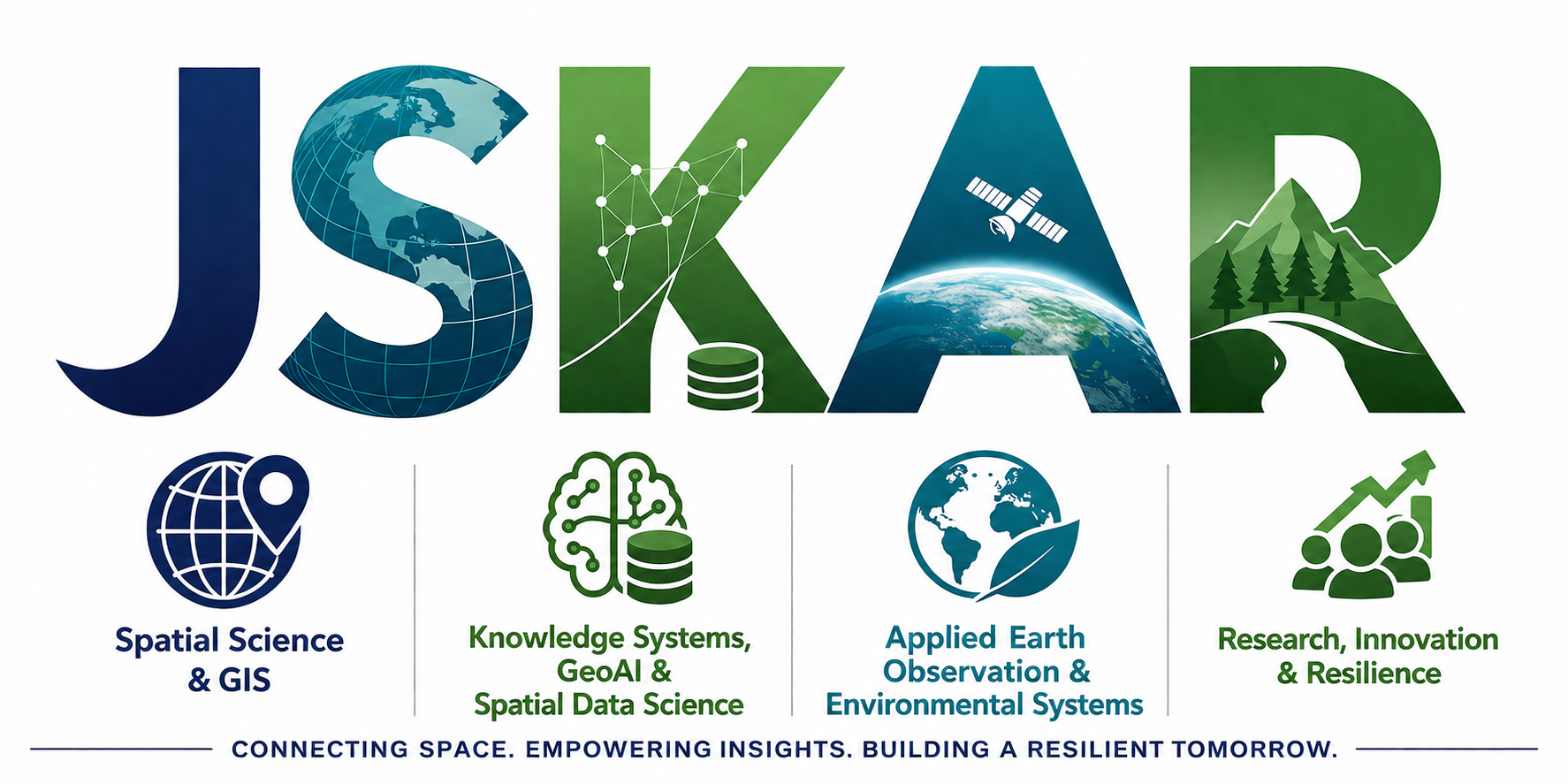
JSKAR's scope is organized around four interconnected dimensions of spatial knowledge, analytical innovation, applied research, and societal understanding.
S — Spatial Science & GIS
Research involving geographic information science, spatial analysis, cartography, spatial modelling, geovisualization, spatial statistics, geographic data management, and applications of spatial methods.
Topics may include:
- Geographic information science (GIScience)
- Spatial analysis and spatial statistics
- Cartography and geovisualization
- Spatial modelling
- Health geography and spatial epidemiology
- Geospatial applications
- Spatial decision support
- Geographic data management
- Urban and regional geography
K — Knowledge Systems, GeoAI & Spatial Data Science
Research advancing computational, analytical, and data-driven approaches to spatial knowledge and geographic information.
Topics may include:
- GeoAI and artificial intelligence
- Machine learning applications
- Spatial data science
- Geospatial databases
- Knowledge systems
- Computational geography
- Cloud geospatial computing
- Reproducible research workflows
- Innovative analytical approaches
A — Applied Earth Observation & Environmental Systems
Research using Earth observation, remote sensing, environmental data, and analytical approaches to understand environmental systems, processes, and change.
Topics may include:
- Remote sensing and Earth observation
- Environmental monitoring
- Land-use and land-cover analysis
- Climate applications
- Ecosystem assessment
- Environmental change
- Natural resource monitoring
- Agricultural and forestry applications
- Water resource management
R — Research, Innovation & Resilience
Interdisciplinary and applied research addressing complex societal, environmental, health, humanitarian, developmental, and technological challenges through evidence, innovation, spatial thinking, and analytical approaches.
Topics may include:
- Interdisciplinary applied research
- Community-based and place-based research
- Innovation and evidence-informed solutions
- Sustainability and resilience
- Humanitarian research
- Development research
- Disaster risk and resilience
- Spatial decision support
- Research addressing complex societal challenges
Interdisciplinary Research
JSKAR encourages research that crosses conventional disciplinary boundaries. The journal recognizes that many contemporary challenges cannot be addressed through a single discipline or analytical approach.
Appropriate interdisciplinary research may involve combinations of geospatial science, environmental research, health, epidemiology, social science, policy, data science, community research, engineering, or other relevant fields.
Examples include:
- Health and epidemiology
- Public health and healthcare access
- Environmental science
- Social sciences
- Policy and governance
- Humanitarian and development research
- Indigenous and community-based research
- Agriculture and food security
- Urban and regional planning
- Disaster management
Research Methods and Approaches
JSKAR welcomes diverse methodological approaches where the research design and methods are appropriate to the research question.
- Quantitative research
- Spatial and statistical analysis
- Geospatial analysis and GIS
- Remote sensing and Earth observation
- Machine learning and GeoAI
- Data science and computational methods
- Mixed-methods research
- Qualitative and participatory approaches
- Community-based research
- Observational and longitudinal studies
- Modelling and simulation
- Reproducible analytical workflows
- Comparative and regional analysis
Research Types
JSKAR welcomes a broad range of scholarly contributions, including:
- Original research articles
- Applied research and empirical studies
- Methodological research
- Data-driven and analytical studies
- Replication and validation studies
- Comparative and regional studies
- Interdisciplinary research
- Reproducible research workflows and analytical frameworks
All submissions must meet the journal's standards for scholarly rigor, appropriate methodology, ethical research practice, and transparent reporting.
Examples of Research Within Scope
Environmental & Earth Observation
- Land-cover change and environmental monitoring
- Climate impacts and adaptation
- Ecosystem assessment
- Environmental risk
- Remote sensing applications
- Natural resource monitoring
Health & Population Research
- Spatial epidemiology and disease mapping
- Health inequalities and access to healthcare
- Population health
- Environmental health
- Health systems and service accessibility
Data, Technology & Analytics
- GeoAI and machine learning
- Spatial databases and cloud computing
- Spatial decision systems
- Reproducible analytical workflows
- Innovative quantitative methods
Social, Community & Place-Based Research
- Place-based research
- Community resilience
- Indigenous and community-based research
- Spatial inequality
- Participatory research
Humanitarian & Development Research
- Disaster response and vulnerability
- Humanitarian mapping
- Displacement and mobility research
- Food security
- Water and sanitation
- Development interventions
Methodological Research
- New analytical frameworks
- Improved spatial methods
- Reproducible workflows
- Data integration
- Applied quantitative methods
Sustainable Development Goals
JSKAR welcomes research contributing to the understanding and advancement of the United Nations Sustainable Development Goals (SDGs) through spatial knowledge, analytical approaches, and evidence-informed solutions.
Relevant research may contribute to areas including:
- SDG 1 — No Poverty
- SDG 2 — Zero Hunger
- SDG 3 — Good Health and Well-being
- SDG 5 — Gender Equality
- SDG 6 — Clean Water and Sanitation
- SDG 10 — Reduced Inequalities
- SDG 11 — Sustainable Cities and Communities
- SDG 13 — Climate Action
- SDG 15 — Life on Land
- SDG 16 — Peace, Justice and Strong Institutions
- SDG 17 — Partnerships for the Goals
SDGs are treated as a cross-cutting application and impact framework within JSKAR rather than as separate or exclusive subject areas.
Research Generally Outside the Scope of JSKAR
A manuscript may be considered outside the journal's scope when it:
- Lacks a clear research question, scholarly objective, or appropriate methodology
- Has no substantive connection to spatial knowledge, analytical inquiry, data-driven research, or relevant real-world applications
- Falls outside established standards of scholarly research
- Provides findings that are insufficiently supported by the methods, data, or evidence presented
- Is primarily promotional, commercial, or non-scholarly in nature
Questions of scope are determined through editorial assessment. A manuscript may be declined without external peer review when its subject, methodology, or scholarly contribution is clearly outside the journal's scope.
Editorial Assessment
JSKAR considers manuscripts primarily on the quality and appropriateness of the research process rather than novelty alone. Editorial and peer-review assessment considers factors such as:
- Methodological quality
- Analytical rigor
- Transparency of methods and reporting
- Appropriate interpretation of results
- Contribution to knowledge and understanding
- Relevance to the research question and stated objectives
Novelty and perceived impact are not primary determinants of editorial quality. However, manuscripts should make a clear scholarly contribution and provide a justified rationale for the research.
Geographic and International Scope
JSKAR has an international scope and welcomes research from all geographic regions. Studies may focus on local, regional, national, or global contexts, including comparative and cross-country research.
The journal particularly values research that provides transferable insights, comparative perspectives, methodological contributions, or evidence relevant beyond a single study setting where appropriate.
Related Journal Policies
For information about how manuscripts are evaluated, see Peer Review Process.
For publication fees, open-access licensing, and author rights, see Publication Fees and Open Access Policy.
For editorial governance, conflicts of interest, and the JSKAR editorial team, see Editorial Team & Governance.
Submit Your Research | Peer Review Process | Publication Fees and Open Access Policy